
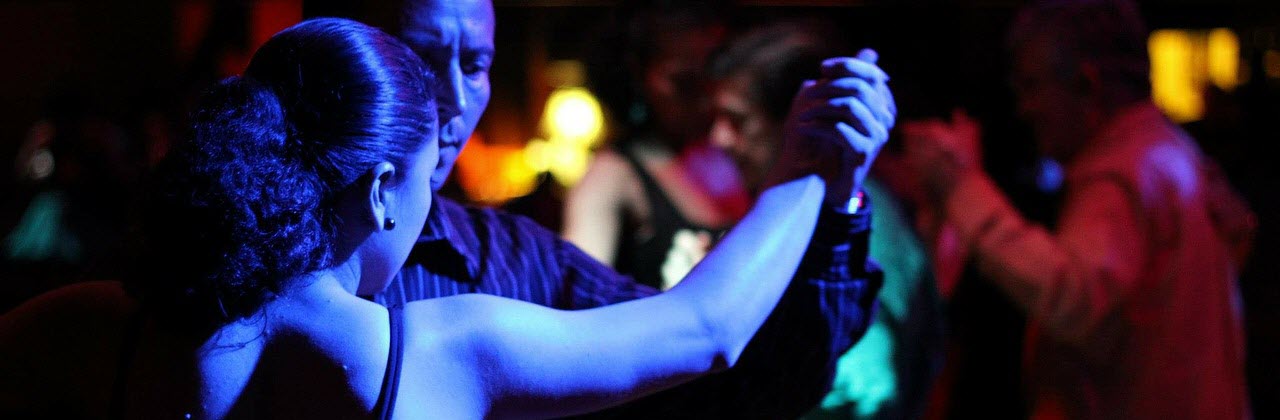
Tango is a partner dance from the second half of the 1800s. It originated along Río de Plata, especially in the poorer districts of Buenos Aires in Argentina och Montevideo in Uruguay.
The early tango was influenced by many different dances and musical styles, of both European, African and local South American origin. Upon close inspection, it is possible to distinguish elements from such varied sources as the German Waltz, the African Candome, the Polish Mazurka, the Bohemian Schottische, the Spanish-Cuban Habanera, and Argentina’s very own Milonga.
When the tango emerged, it quickly gained a very bad reputation in Argentina och Uruguay, since it was strongly associated with gangsters, brothels and seedy bars. The tango has come a long way since then, and in 2009 UNESCO approved a joint proposal by Argentina and Uruguay to include tango in the UNESCO Intangible Cultural Heritage List.
Cultural importance
Tango has influenced every part of our society. An example of this is that day traders and binary options traders use something they call a tango line to be able to predict future market movements. The Tango line is when the market make a sharp move in a new direction similar to the steps when you are dancing tango. The Tango line can indicate that the market have hit its peak or bottom.
Styles
Many different styles of tango have developed throughout the years, with some becoming more popular, long-lasting and widespread than others. As tango dancing and tango music spread across the globe, it picked up elements from the cultures in which it was practiced.
Here are a few examples of different tango styles. Many of them can be further divided into substyles.
- Ballroom tango (International style or American style)
- Contact tango
- Finnish tango
- Show tango (also known as Fantasia)
- Tango Argentino
- Tango camacupense (Angola)
- Tango Canyengue
- Tango liso
- Tango milonguero (Tango apilado)
- Tango nuevo
- Tango oriental
- Tango orillero
- Tango salon
- Tango Valparaísino (from Valparaíso, Chile).
- Tango vals
- Tango Uruguay
Early tango history
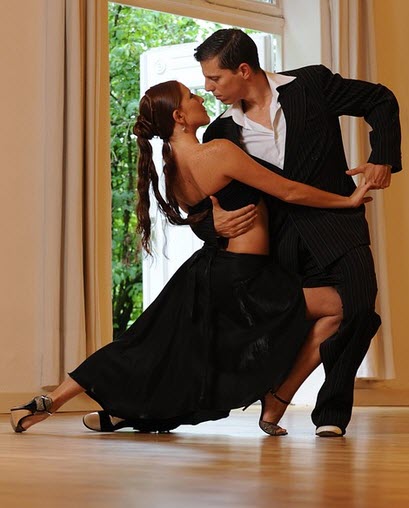
As mentioned above, tango as we know it today developed in Argentina och Uruguay during the second half of the 19th century. The oldest surviving records of the word tango in Argentina are from the 1890s.
For many years, tango was associated with the underworld and was certainly not something that would be danced or even listened to by respected members of bourgeois families. This began to change a bit around the turn of the century, and in 1902 the Teatro Opera in Buenos Aires started to include tango in their balls. Still, for many, tango retained its seedy associations. Not only was the dance highly sensual, it was also a dance that was very popular in poor suburbs in the outskirts of the city and in the more centrally located working-class slums.
Tango proved a great success for the growing record industry in Argentina and for the years 1903-1910 over a third of the new gramophone records were tango music. For the period 1910-1920, the tango share was even greater, with 2,500 tango records out of a total of 5,500.
Tango goes to Europe
In the early 1910s, dancers and musicians began to travel from South America to perform in Europe, starting tango crazes in places such as Paris, Berlin, London and Helsinki. In Great Britain, tango schools popped up, but they agreed to teach a style of tango that was less improvisational and also had less body contact.
Growing acceptance back home
As tango had proved popular among the European bourgeois and even among the aristocracy, South American high society could finally fully embrace it and proudly take both the dancing and the music to their hearts.
In 1920, Julio De Caro – a classically trained violinist – formed an orchestra promoting a more elegant, refined and somewhat slower version of tango. Before this, classically trained musicians normally shied away from the tango in South America.
The History & Evolution of Argentine Tango
From the Rio de la Plata arrabales and the Golden Age of Orquestas Típicas to Nuevo Tango and UNESCO immortality
| Era / Period | Historical Stage | Musical / Choreographic Core | Cultural Dynamics & Key Milestones |
|---|---|---|---|
| 1880 – 1910 | La Guardia Vieja (The Old Guard) Origins & Arrabales | Flute, Violin, Guitar & Accordion (Habanera / Candombe roots) | Tango emerged in the peripheral port slums (arrabales) of Buenos Aires and Montevideo, born from the syncretism of African-Argentine candombe, Cuban habanera, and Andalusian flamenco. Popularized by working-class immigrants and compadritos in brothels and courtyards (conventillos). Angel Villoldo penned the immortal anthem El Choclo (1903). |
| 1910 – 1920 | Tangomania in Paris & Bandoneón Arrival Global Legitimacy | Entry of the German Bandoneón; Smoothed European Salon Style | Upper-class Argentine youths brought tango to Paris saloons, sparking “Tangomania” across London, Berlin, and New York. International acclaim purged the dance’s disreputable brothel stigma back home. Simultaneously, the German bellows instrument, the bandoneón, replaced the flute, injecting the melancholic, sighing timbre that defined modern tango. |
| 1917 – 1935 | The Birth of Tango-Canción (The Gardel Era) Vocal Lyricism | Lyrical Baritone & Guitar Quartets; Lunfardo Slang Poetry | In 1917, Carlos Gardel recorded Mi Noche Triste, inventing the narrative tango-canción. Songs evolved into philosophical, heartbreaking mini-operas addressing betrayal, existential longing, and the vanishing barrio. Gardel’s international film stardom with Paramount made tango a worldwide sensation until his tragic death in a 1935 plane crash in Medellín. |
| 1935 – 1955 | La Edad de Oro (The Golden Age) Peak Milongas | Orquesta Típica (4 Bandoneones, 4 Violins, Piano, Double Bass) | Juan D’Arienzo accelerated the tempo back to a sharp 2/4 beat in 1935, reigniting mass social dancing. Hundreds of live dance halls (milongas) packed sports clubs nightly. Iconic orchestra leaders forged distinct styles: D’Arienzo (the rhythmic driver), Carlos Di Sarli (lyrical nuance and bass walks), Aníbal Troilo (expressive melodic depth), and Osvaldo Pugliese (dramatic polyrhythmic syncopation). |
| 1955 – 1980 | Persecution, Rock Invasion & The Underground The Dark Years | Intimate Cavern Ensembles; Survival in Secret Milongas | Following the 1955 military coup against Juan Perón, political crackdowns banned large public gatherings. State repression coupled with the arrival of Anglo-American rock & roll decimated large orquestas típicas. Tango retreated into underground cafés and intimate listening clubs (tanguerías), preserved by resilient old-guard dancers. |
| 1960 – 1990 | Tango Nuevo: The Astor Piazzolla Revolution Concert Hall Modernism | Quinteto (Bandoneón, Electric Guitar, Bass, Violin, Piano); Jazz & Classical Counterpoint | Trained under Nadia Boulanger, Astor Piazzolla radically revolutionized the genre by breaking away from dance-hall constraints, fusing Bach counterpoint, Stravinsky dissonance, and jazz improvisation into Tango Nuevo (e.g., Adiós Nonino, Libertango). Initially rejected as “heresy” in Buenos Aires, it conquered premier international concert halls. |
| 1983 – 2000s | “Tango Argentino” Stage Revival & Global Boom Global Stage Triumph | Virtuosic Stage Tango (Ganchos, Boleos, Lifts) & Traditional Social Codes | With Argentina’s return to democracy in 1983, the Broadway and Paris hit theatrical show Tango Argentino sparked a worldwide revival. Dancers flocked from Tokyo, Berlin, and San Francisco to Buenos Aires to learn authentic floorcraft (caminata, giros, and the abrazo) from veteran maestros. |
| 2000s – Present | Electrotango, Queer Tango & UNESCO Inscription Contemporary World Heritage | Electronic Downtempo Beats (Gotan Project, Bajofondo); De-gendered Lead-Follow Roles | Electronic groups synthesized tango with trip-hop, while contemporary milongas embraced role-fluid “Queer Tango.” In 2009, UNESCO officially inscribed Argentine and Uruguayan Tango on the Representative List of the Intangible Cultural Heritage of Humanity, cementing its enduring cultural immortality. |
This article was last updated on: September 28, 2026

